We have all found ourselves caught in the polite corporate loop. You need a specific data set or a critical status update to meet an impending deadline. Because you are committed to leading with a collaborative, coach-like mindset, you choose to ask nicely. You use the soft, standard phrasing designed to invite ownership: "Whenever you have a moment today, could you please send over those metrics?"
A day passes. Nothing. You follow up, keeping the tone light and supportive. Still nothing.
Eventually, the deadline arrives, the pressure mounts, and the luxury of patience evaporates. You drop the open-ended questions, look the team in the eye, and say exactly what the moment requires: "This is what I want. Do it now and just give me the information."
The immediate reaction is often a noticeable change in the atmosphere, a mix of shock and discomfort. Later, you might even hear whispers that your approach was too "aggressive." In my case, a senior leader pulled me aside shortly afterward, looking genuinely perplexed. "But you’re a coach," they noted. "Why did you have to handle it that way?"
My response was direct: "Well, sometimes we just have to be direct."
There is a persistent, almost dogmatic belief in modern management that once you adopt an executive coaching workplace philosophy, you are fundamentally barred from ever giving a straight command. We fall into the trap of trying to turn every basic operational transaction into a reflective learning journey. It is exhausting, inefficient, and fundamentally misinterprets the balance between coaching vs directing leadership.
The Problem with Perpetual Consensus: When Coaching Fails
Coaching relies heavily on the Socratic method—using inquiry to help individuals uncover their own insights and build long-term capability. While this is an invaluable asset for talent development, overusing it in the wrong context creates significant operational drag. When a leader refuses to pivot out of an inquiry mode, urgency disappears, accountability blurs, and teams begin to view mandatory deliverables as optional suggestions.
We have to look at the reality of modern organizational complexity. A recent analysis by Deloitte Insights on the evolution of leadership highlights that while modern environments demand continuous learning and shared purpose, authority and clear structural anchors remain essential to navigate high-uncertainty environments. When a timeline is compressed, a leader cannot afford to spend days waiting for a team member to "discover" the answer to a basic data request.
True leadership agility is not about adhering to a single, soft-spoken methodology. As I explored in my previous article, The Mirror, Not the Mechanic, a coach’s standard role is to hold space and act as a mirror so teams can process their own challenges. However, a dynamic situational leadership style requires you to recognize when the context changes. When operational velocity is the priority, you must step away from the mirror, pick up the direct tools of leadership, and eliminate communication drag to keep the business moving forward.
Coaching vs Directing Leadership: The Operational Boundary
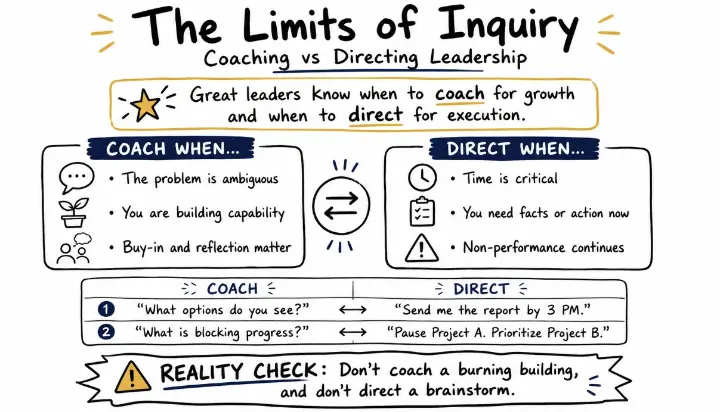
To maintain operational velocity, professional coaches and leaders must clearly distinguish when to coach team members and when to demand execution. The framework for this choice comes down to resource availability and the nature of the task.
1. When to Deploy Coaching Mechanisms
Coaching is an investment in the future. According to the core competencies outlined by the International Coaching Federation (ICF), professional coaching is designed to "evoke awareness" and facilitate client growth. This methodology belongs in scenarios where the stakes allow for a learning curve:
- Strategic Problem-Solving: When a team needs to navigate an ambiguous challenge and requires deep critical thinking.
- Capability Building: When an employee is stepping into expanded responsibilities and needs to develop autonomous decision-making skills.
- Long-Term Alignment: When deep buy-in is required for a major cultural or operational shift.
2. When to Use Direct Leadership
Direct leadership is an investment in the immediate present. It is required when the primary objective is compliance, speed, or accuracy rather than psychological growth:
- Operational Deadlines: When time is a constraint and delays will cause systemic friction for the broader organization.
- Objective Data Gathering: When you are asking for established facts, existing spreadsheets, or administrative updates. You do not need to coach someone through emailing a document; you simply need the document.
- Persistent Non-Performance: When collaborative prompts and supportive check-ins have already been bypassed multiple times.
| Operational Scenario | The Coaching Approach (Growth) | The Direct Approach (Execution) |
| Missing Data / Reports | "How can we ensure these metrics are delivered consistently?" | "I need the Q2 spreadsheet in my inbox by 3:00 PM today." |
| Project Roadblocks | "What bottlenecks are you facing, and what is your next step?" | "Halt work on Project A and prioritize Project B immediately." |
| Basic Quality Alignment | "How do you evaluate the current structure of this report?" | "The formatting must align with company templates. Please adjust it now." |
Reframing Clear Communication in Leadership
The pushback that directness equals aggression deserves a closer look. In many corporate cultures, professionals have become so accustomed to hyper-padded, conflict-averse language that a straightforward instruction feels like a shock to the system.
However, as experienced leaders, we must recognize that clear communication in leadership is a form of respect. Leaving a team to guess the actual stakes of a timeline, only to penalize them when the project fails, is a failure of leadership.
There is nothing aggressive about setting a firm boundary and demanding accountability.
When you say, "Do it now and give me the information," you are not attacking an individual’s capability; you are removing the ambiguity surrounding the priority. You are establishing that the window for dialogue has closed, and the window for execution is open.
The Reality Check
To the executives and observers who wonder why a certified coach would ever drop the Socratic method and issue a blunt directive: we do not operate in a therapeutic vacuum. We operate within a commercial framework that requires tangible outcomes.
Coaching tools are exceptionally powerful, but they are instruments, not a religion. A leader knows that you do not coach a burning building, and you do not direct a creative brainstorming session. Sometimes, the most professional, responsible action a leader can take is to stop asking questions, state the requirement clearly, and expect immediate execution.
"Infographics and images are generated with the assistance of AI"