Silence: A Coaching Superpower.
Picture this: you've just asked your client a powerful question. They pause. Something stirs beneath the surface. And then, almost instinctively, you reach for words to fill the gap.
What if that instinct is costing your clients their breakthrough?
In a profession built on conversation, silence is the most misunderstood tool in a coach's arsenal. Yet the evidence is clear: learning to sit with silence and hold it with confidence, can transform a good session into an extraordinary one.
Why Silence? The Neuroscience Makes the Case
Most coaches enter a session with an instinct to do — ask, respond, probe. But doing less, at the right moment, often enables a client to do more.
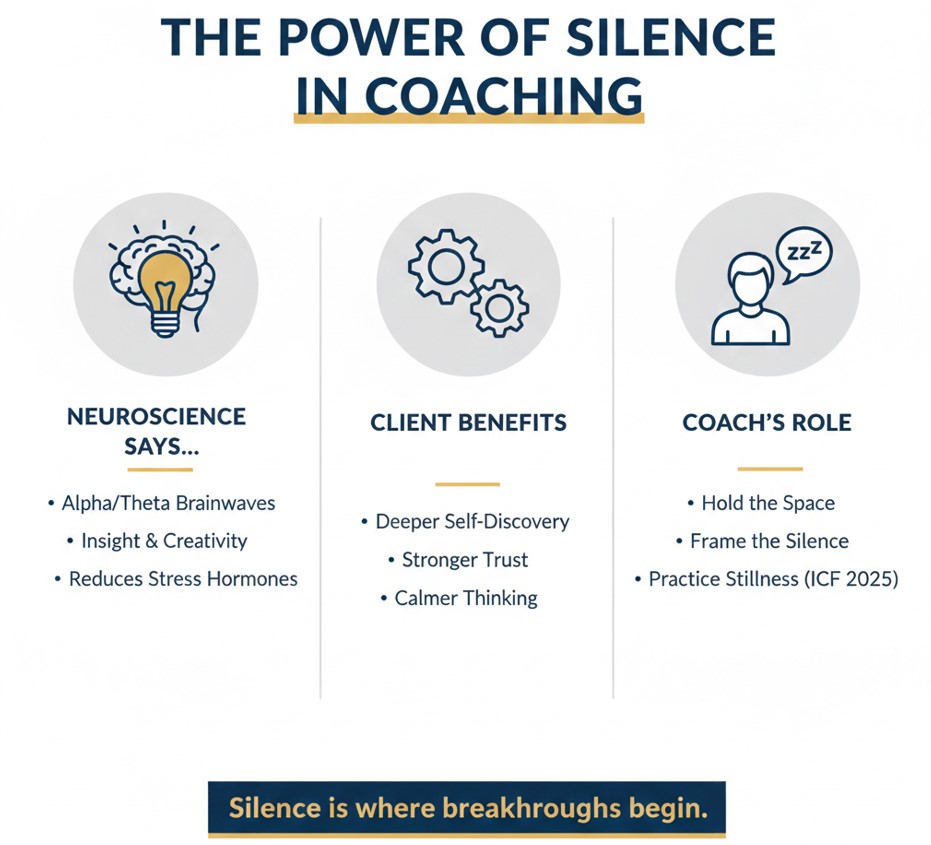
The updated ICF Core Competencies for 2025 now explicitly name silence as a facilitation tool alongside questioning and metaphor, a formal recognition that it belongs at the heart of skilled coaching.
The neuroscience backs this up. A 2025 synthesis of brain research confirms that quiet prompts the brain to shift from high-alert beta waves into slower alpha and theta states, precisely where insight, creativity, and new understanding are born. When you allow a client to sit in silence after a powerful question, you're not wasting time. You're creating the neurological conditions for genuinely new thinking.
As Dr. Marcia Reynolds writes in Breakthrough Coaching (2024): "Discomfort is evidence that a new awareness is forming." That slight unease when silence falls? It's not a sign something's wrong. It's often the sign something important is about to happen.
Not All Silence Is the Same
Coaching Studies International (2025) identifies six distinct types, each serving a different purpose:
- Centering silence: opens the session and grounds both coach and client
- Reflective silence: holds space after an insight, so it can land
- Supportive silence: communicates presence without a single word
- Empathic silence: makes room for emotion without rushing past it
- Generative silence: the pause before a client surprises themselves with an answer
- Transitional silence: a breath between topics that honours what came before
Recognising which silence a moment calls for is where craft meets intuition, and it's a skill that deepens with deliberate practice.
What the Research Shows
Three outcomes appear consistently when silence is used with intention:
Deeper self-discovery. The British Psychological Society found that silence creates what clients themselves described as a liminal space, a protected pause where understanding unfolds organically, in ways no question could have guided them to.
Stronger trust. Research from Coaching Outside the Box (2025) found that clients who experience intentional silence often feel more heard than in sessions full of back-and-forth. In a world where focused, unhurried attention is rare, silence is an act of profound respect.
Calmer thinking. Studies on silence and the nervous system show that intentional quiet reduces stress hormones and supports regulated, open attention. Clients can't access their best thinking while activated. Silence gives the nervous system permission to settle.
One important caveat: a 2024 study in Counselling and Psychotherapy Research found that clients with attachment anxiety can experience silence as abandoning, unless the coach's nonverbal presence is warm and grounded. The message is simple: silence must always be held with the client, never withheld from them.
Three Things Every Coach Should Know
Your discomfort is data, not direction. The urge to speak during silence is almost always about your discomfort, not the client's need. The Institute of Coaching (2025) puts it plainly: "The discomfort of silence is a sign of progress." Sitting with that discomfort, rather than acting on it, is one of the most important edges a coach can work on.
Frame it. A single phrase like "Take all the time you need" doesn't break silence, it shapes it. It tells the client the pause is intentional and safe, dramatically reducing the risk they experience it as disconnection.
Practise it in your own life. You can't offer something you don't inhabit. Notice how often you reach for noise to fill quiet moments. Begin sitting with them instead. Your ability to hold silence for a client grows in direct proportion to your own comfort with stillness.
Your Challenge for This Week
In your next session, ask one powerful question, and then wait. Let five seconds pass. Then ten. Notice your impulse to speak, and choose differently.
What you'll often find is that your client had the answer all along. What they needed wasn't another question. It was the permission to hear themselves think.
Silence isn't the absence of coaching. In its deepest form, it is coaching, at its most human, and its most powerful.