The offices are quieting down. The Slack & Teams channels are finally slowing their scroll. Here in Bangkok, the year-end heat is settling in, and across the globe, business leaders are doing the same thing: looking at the P&L for 2025 and setting the targets for 2026.
We have lived through a year of breathless acceleration. 2025 was the year AI integration moved from "experimental" to "operational." We optimised, we automated, and we scaled. But as I sit with executives and coaches this week, I am hearing a common, quiet confession: “We hit or did not our numbers, but our people are running on fumes.”
As we stand in these final days of the year, I want to challenge your strategy for the first week of January. The most critical lever you can pull to ensure a successful 2026 isn't a new KPI, a new software rollout, or a restructuring plan.
It is strategic appreciation.
If 2025 was about the speed of technology, 2026 must be about the depth of humanity. Here is why the way you motivate your team in the next 30 days will define your entire year.
The Current Landscape: The "Appreciation Deficit" of Late 2025
Let’s be honest about the state of the workforce as we close this year. While productivity metrics soared in 2025, emotional capital plummeted.
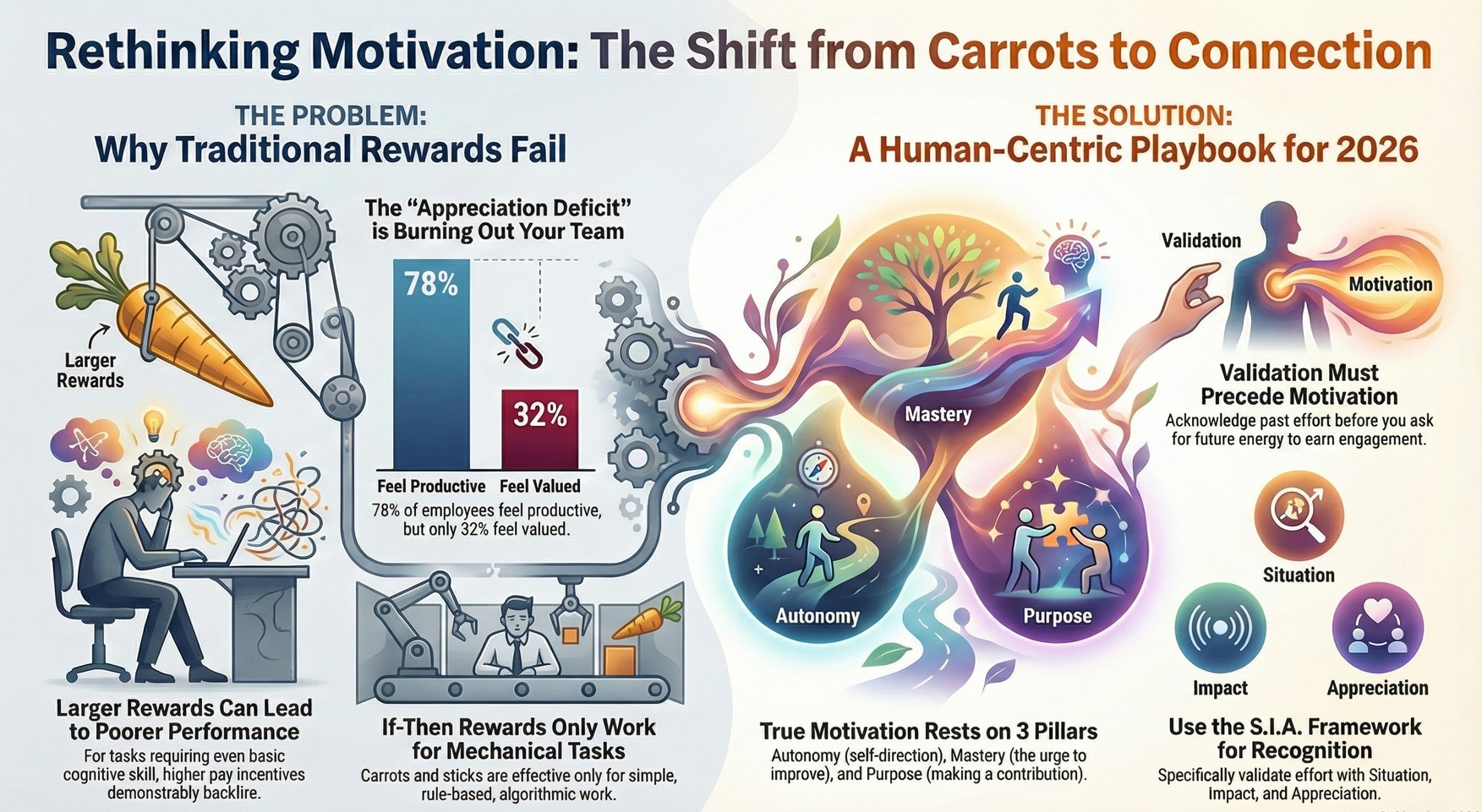
Recent data paints a stark picture. The Global Talent Trends Report Q4 2025 indicates that while 78% of employees feel "productive," only 32% feel "valued." That gap, the 46% chasm between what people do and how they feel, is where turnover happens.
We spent 2025 treating our teams like high-performance engines. We optimised the fuel (tools) and the track (processes), but we forgot to maintain the driver. The primary challenge facing us in January is not competence; it is depletion.
If you launch into 2026 demanding "more, faster, better" without first acknowledging the massive lift of the last 12 months, you will face a rebellion of disengagement. The silence you hear isn't focus; it's resignation.
Back to Basics: The "Look Back" Before the "Look Forward"
So, how do we fix this? How do we start 2026 right?
We need to go back to the basics of human psychology: Validation precedes motivation.
I advise leaders to radically alter their first meeting of the year. Usually, the "Jan 1 Kickoff" is a barrage of future targets. This year, I want you to flip the script.
The Strategy: The Retroactive Recognition Before you talk about Q1 goals, you must spend significant time specifically validating 2025’s struggles and wins.
Research published in Harvard Business Review (October 2025) suggests that "narrative recognition", telling the story of an employee's contribution rather than just rewarding the outcome, increases retention intention by over 40%.
Actionable Framework for Week 1, 2026: Instead of generic praise, use the S.I.A. Framework (Situation, Impact, Appreciation):
- Situation: "I know moving to the new cloud system in October was incredibly messy."
- Impact: "But because you stayed late to troubleshoot the migration, the sales team didn't miss a single lead."
- Appreciation: "That resilience set us up for this year. Thank you."
When you start the year by proving you saw their effort, you earn the right to ask for their energy in 2026.
Future Outlook: The "Human-First" Era (2026-2028)
Looking ahead, the role of the leader is shifting fundamentally. As we enter 2026, we are leaving the "Manager Era" and entering the "Coach Era."
The technological landscape of the next three years will commoditise "hard work." AI will do the heavy lifting. The competitive advantage of your company will be the creative energy of your people, and creative energy requires a tank full of appreciation.
Here are my predictions for the motivation landscape of 2026-2028:
- Micro-Validation over Annual Reviews: The annual review is dead. The emerging standard, supported by findings from Deloitte’s 2025 Human Capital Trends, is "flow-of-work" feedback. Leaders who can provide real-time, micro-doses of appreciation (daily/weekly) will outperform those relying on quarterly cycles.
- Emotional Salary: "Emotional Salary" will become a tangible metric. Top talent will choose employers based on the emotional ROI of the job. Do I feel good here? Am I seen? If the answer is no, they will leave, regardless of the paycheck.
- The Return of "Gathering": After years of hybrid confusion, 2026 will see a deliberate return to "gathering for connection," not "gathering for work." We will see leaders using office time exclusively for bonding, celebration, and appreciation, leaving the deep work for the home office.
Your First Move in 2026
As the calendar turns, you have a choice. You can start 2026 with a demand, or you can start it with a deposit.
My challenge to you is this: In the first week of January, do not send a single email about targets until you have sent five emails about gratitude.
Identify the people who carried the load in 2025. Call them. Write to them. Be specific. Be authentic. Tell them exactly why they matter to the mission.
If you fill their cup in January, they will run through walls for you in June.
Let’s not just start a new year. Let’s start a new standard of leadership.
Here’s to a human-centric 2026.
I always remember this bit of knowledge (a YouTube Video) shared to me 14 years ago by someone I really respect.