In my last article, we debunked the myth of the "cheap" supplier. We explored how the lowest sticker price often masks an iceberg of operational risks, ethical liabilities, and long-term costs.
But exposing the trap is only half the battle. If we agree that buying based solely on price is a race to the bottom, the obvious question for any Chief Procurement Officer (CPO) or Supply Chain leader becomes: What is the alternative?
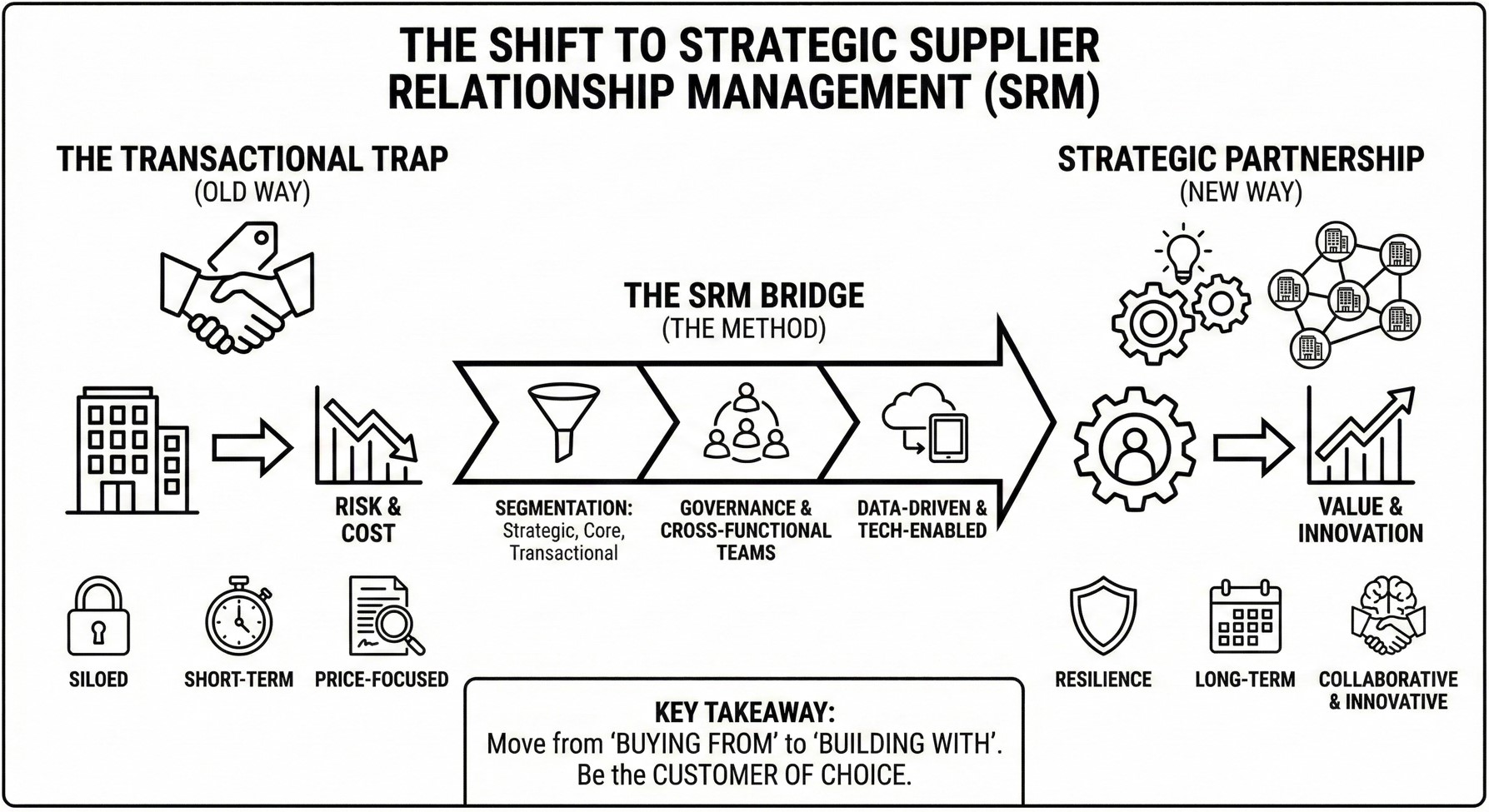
The answer isn't just "buy better quality." It is a fundamental shift in how we view the entities on the other side of the contract. It is the shift from Vendor Management to Supplier Relationship Management (SRM).
For decades, SRM has been a buzzword thrown around in boardrooms, often reduced to a fancy term for "beating suppliers up over lunch." But in the post-pandemic era, where volatility is the only constant, SRM has ceased to be a "nice-to-have." It is now a survival mechanism.
Here is why your relationship with your suppliers is likely the most undervalued asset on your balance sheet, and how you can manage it to drive real, hard-dollar value.
The Mathematics of Collaboration
Let’s get the skepticism out of the way first. Many CPOs worry that "partnerships" are just a way for suppliers to increase margins without delivering extra value.
The data suggests the exact opposite.
McKinsey & Company has found that companies who regularly collaborate with suppliers demonstrate higher growth, lower operating costs, and greater profitability than their industry peers. In fact, leaders in supplier innovation tend to beat industry growth trends by 2x.
Why? Because your suppliers are the experts in their field. They know the new materials, the manufacturing shortcuts, and the logistical efficiencies long before you do. When you treat them as transactional vending machines, they give you exactly what you ordered, nothing more.
But when you build a relationship based on trust and shared value, you unlock Supplier Innovation. You stop paying for a product and start paying for a solution.
The "Customer of Choice" Dividend
During the supply chain crunches of the last 5 years, we saw a phenomenon that separated the good procurement teams from the great ones: the concept of being a "Customer of Choice."
When raw materials are scarce, or a factory is running at 110% capacity, who gets their order filled first? It isn’t always the company paying the highest price. It is the company that is easy to work with, pays on time, and has a history of fair dealing.
Harvard Business Review notes that in a post-pandemic world, resilience requires a shift from "just-in-time" efficiency to "just-right" redundancy and deep collaboration.
Being a Customer of Choice means you get the first call when a disruption hits. It means you get the "A-team" working on your account. It is an insurance policy that you cannot buy; you have to earn it.
How to Manage It: Structure Over Sentiment
So, how do you move from a transactional mindset to a strategic one? It isn't about being "nice." It requires rigorous governance.
1. Ruthless Segmentation You cannot be best friends with everyone. A common mistake is trying to apply SRM to the entire supply base. This is a waste of resources.
According to PwC’s research on SRM, best-in-class organisations segment their suppliers not just by spend, but by risk and strategic potential.
- Strategic Partners: (Top 1-5%) These are the relationships that can make or break your business. They require executive sponsorship, joint innovation funds, and complete transparency.
- Core Suppliers: Essential, but managed through performance KPIs and standard governance.
- Transactional: Automate these. Don't waste human capital here.
2. Breaking the Silos The biggest enemy of effective SRM is internal misalignment. Procurement might promise a strategic partnership, but if Accounts Payable is paying them 60 days late, or Engineering keeps rejecting their innovative ideas, the relationship crumbles.
A recent Deloitte Global CPO Survey highlighted that 57% of CPOs identify organisational silos as the major obstacle to delivering value.
Effective SRM requires a cross-functional team. The "relationship manager" shouldn't just be a buyer; it should be a squad involving Quality, R&D, and Operations.
3. Data-Driven Transparency "You cannot manage what you do not measure". But stop measuring just "On-Time-In-Full" (OTIF).
Advanced SRM programs share data both ways. Share your demand forecasts with your suppliers so they can plan better (lowering their costs, and eventually yours). Ask them to share their Tier-2 risks with you.
Gartner reports that over 75% of procurement leaders are now prioritising these closer, data-rich relationships. Why? Because transparency builds trust, and trust lowers the cost of doing business.
The Role of Technology: Automating the Mundane
You might ask, "Who has time for all these meetings?"
This is where the new wave of procurement tech comes in. We are seeing a massive shift where AI and automation handle the transactional noise, the POs, the invoices, the compliance checks.
Deloitte notes that 92% of CPOs are actively monitoring or deploying Generative AI solutions. The goal isn't to replace the procurement professional, but to free them up.
If your buyers are spending 80% of their time chasing invoices, they have 0% time to discuss innovation with suppliers. Use technology to clear the deck so your human talent can focus on the human element of the supply chain.
Conclusion: The Two-Way Street
Ultimately, Supplier Relationship Management is about recognising that your suppliers are businesses too. They have profit margins, shareholders, and strategic goals.
If your strategy is solely to extract value from them, you will eventually hit a wall. But if your strategy is to create value with them, the ceiling is limitless.
As we move forward in 2026, the CPOs who win won't just be the best negotiators. They will be the best orchestrators, bringing together external capabilities to solve internal challenges.
Don't just buy from your suppliers.
Build with them.