The Ghost of 1970s Finance Returns
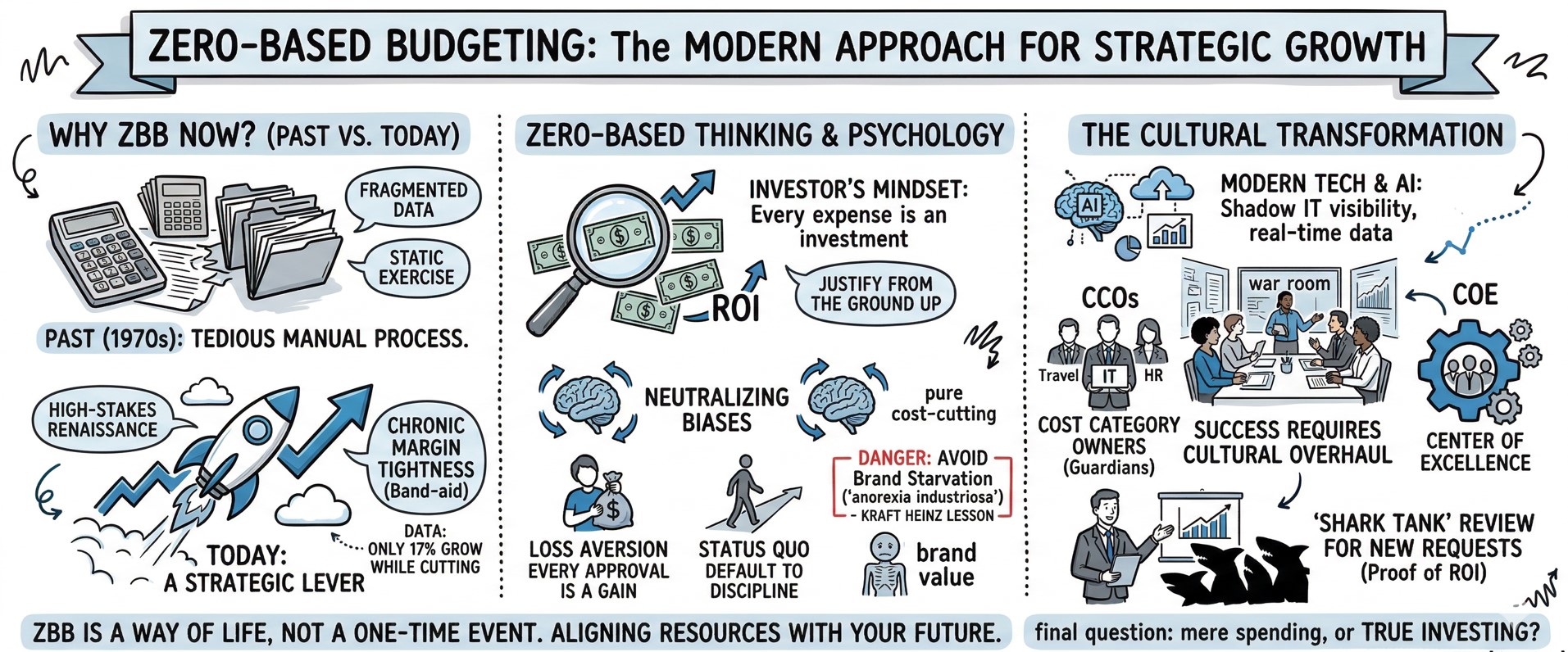
Zero-based budgeting (ZBB) has long been the "ghost" haunting corporate finance, a reputation forged in the late 1970's as a tedious, manual ordeal famously attempted by the Carter administration to overhaul federal spending. For decades, it was dismissed as a relic of a slower era, replaced by "incremental budgeting," the safe but uninspired practice of tinkering with last year’s blueprint. Today, that ghost is not just returning; it is leading a high-stakes renaissance.
Modern organisations are trapped in a cycle of "chronic margin tightness," where traditional cost-cutting acts more like a temporary bandage than a cure. The data is sobering: a McKinsey study of 238 companies found that only 26% sustained their cost reductions for four years. Even more telling? Only 17% managed to grow while cutting. In this climate of disruption, ZBB has re-emerged as the strategic lever for those who realise that the old rules of "cutting x percent" no longer apply.
Takeaway 1: You Can’t Cut Your Way to Prosperity (But ZBB Can)
The most persistent myth about ZBB is that it is a tool of austerity. In reality, modern ZBB is a lever for growth. Traditional budgeting is anchored to the past, often carrying over "unproductive" spending simply because it was there last year. ZBB breaks this cycle by requiring every dollar to be justified from the ground up, effectively turning "my resources" into "our resources."
By adopting an "investor’s mindset," managers stop viewing budgets as a "hall pass" for spending and start treating every expense as an investment that must produce a return. This shift allows businesses to identify resources that can be reallocated to fuel strategic priorities and innovation.
"Businesses can’t just cut their way to prosperity. The surprisingly powerful tool to help an organisation grow? Zero-based budgeting." McKinsey & Company
Takeaway 2: The "Anorexia Industriosa" Warning (The Kraft Heinz Lesson)
If ZBB is used purely as a curtailment strategy, it becomes a self-inflicted virus. The case of Kraft Heinz serves as the ultimate cautionary tale of what branding analysts call "anorexia industriosa", the starvation of iconic brands to satisfy short-term shareholder gains. It was the Vietnam-era strategy applied to finance: they had to destroy the village to save it.
While the 3G Capital-led merger initially saw profit margins soar, the obsession with pure cost-cutting eventually led to a massive $15.4 billion impairment charge in 2018. More damaging than the write-down was the "analytical grit" behind the failure: an SEC investigation into procurement malfeasance eventually uncovered $208 million in fictitious cost savings. Analysts and forensic researchers highlight three fatal factors:
- Significant Debt and Overvaluation: High debt loads and the over-valuation of goodwill created a house of cards that could not support long-term growth.
- Starvation of Innovation: ZBB was used to siphon off money meant for brand-building and market research, leaving the organization blind to shifting customer health trends toward organic and fresh foods.
- Procurement Malfeasance: The pressure to deliver "savings" led to ethical and accounting shortcuts, necessitating the reissuance of financial statements and $62 million in SEC penalties.
Takeaway 3: Hacking the Human Brain (The Psychology of Zero)
ZBB is effective because it neutralises deep-seated psychological biases that lead to corporate bloat. By understanding the "psychology of zero," organisations can change behavior more effectively than through any top-down mandate:
- Loss Aversion (The Endowment Effect): Humans naturally fear losing what they already have. ZBB neutralises this by framing the budget as building up from a zero base—making every approved dollar feel like a strategic gain rather than a painful loss.
- Status Quo Bias: People default to the path of least resistance. ZBB makes cost discipline the new "default" by requiring active justification for every expense, rather than allowing legacy costs to renew automatically.
- Accountability: Humans behave more responsibly when they feel "watched." In a famous "honesty box" experiment, payments for coffee tripled when a picture of eyes was posted nearby. In the corporate world, this translates to radical transparency. For example, some companies now openly discuss the specific cost of printing for a meeting during that very meeting, instantly fostering a "Do I really need this?" mindset.
Takeaway 4: AI and the Cloud are Giving ZBB a Second Life
The primary reason ZBB failed in the 1970's was the "tedious and time-consuming" manual workload. Modern technology has solved this. Cloud-based platforms and Generative AI tools, such as Synergy.AI, now provide real-time cost transparency and automated diagnostics. These tools allow for "like-for-like" cost comparisons across global entities and can even uncover "shadow IT", hidden spending occurring outside formal budget allocations.
| Old ZBB (1970's) | Modern ZBT (Digital Age) |
| Tedious manual entries and offline spreadsheets | AI-powered diagnostics and automated data validation |
| Fragmented data; 10,000+ disparate sheets | Real-time cost transparency and P&L-linked savings |
| Periodic, static exercise | Unified governance and continuous "track-and-trace" |
Takeaway 5: It’s a Cultural Transformation, Not a Math Problem
Successful ZBB requires a complete overhaul of corporate governance. It is not a project for the finance department; it is a permanent change in how work gets done. This requires a "Going All In" approach to cultural transformation, exemplified by the appointment of a credible ZBB Director who often reports directly to the CEO.
- Cost Category Owners (CCOs): These high-performing individuals spend 20% of their time overseeing specific spend categories. They are the guardians of efficiency, challenging their peers to meet targets.
- Center of Excellence (COE): A dedicated "war room" of Finance, IT, and HR professionals who maintain discipline even after the initial enthusiasm wanes.
- The "Shark Tank" Review: Incremental spending is no longer a "given." Instead, it is centrally reviewed in a competitive environment—much like a corporate "Shark Tank"—where managers must prove the ROI of new requests against strategic priorities.
"After a year, leaders at the highest-performing companies stop calling it ZBB: they call it 'how we get work done.'" McKinsey & Company
Conclusion: The Future of the "Bottom Line"
Zero-based budgeting is not a one-time event; it is a "way of life." It moves the organisation away from historical artifacts and toward active, strategic choices made in the present. By stripping away the inertia of the past, ZBB ensures that your resources are always aligned with your future.
Is your current budget a reflection of who you were three years ago, or is it a strategic choice made for the market you face today?
The question for every leader is simple: Are you merely spending, or are you truly investing?
In my Next post I will provide a 10 Month Zero based Budget Guide