Introduction: The Evolution of Value
If you have been following my recent discussions, we have already dismantled the dangerous obsession with the lowest price. In The Cheap Trap, we explored why a low sticker price is often a mirage. In Beyond the Contract, we argued that strong relationships and being a "Customer of Choice" are your best defense against disruption.
But once you have the right mindset and the right partners, you still need to do the math.
And in 2026, the math has changed.
For decades, we used the "iceberg" model to explain Total Cost of Ownership (TCO), the idea that hidden costs lurk beneath the surface. But today, I am challenging that metaphor. Icebergs are static, they drift slowly and melt quietly. Today’s supply chain risks, driven by the volatile macroeconomic landscape of 2025 and 2026, are dynamic, interconnected, and explosive.
For small business owners and university students alike, we need to move from a static "hidden cost" model to a "TCO Ecosystem" approach. Here is how to calculate value when the rules of global trade are being rewritten.
The 2025-2026 Landscape: Volatility is the New Baseline
To calculate cost effectively, you must first understand the arena. The last 18 months have fundamentally shifted us from "Just-in-Time" efficiency to "Total Value" resilience.
Unlike the "soft skills" of relationship management we discussed previously, this requires hard data. The primary friction points impacting your TCO right now include:
- The Tariff Reshuffle: As trade policies harden between major economic blocs, "landed cost" is now a moving target. A supplier might be cheap today, but a sudden 20% retaliatory tariff can destroy that value overnight.
- Capital is Costly: While inflation has cooled since the post-pandemic peaks, interest rates remain structurally higher than the "free money" era of the 2010s. Holding excess inventory now carries a punishing carrying cost (warehousing + cost of capital).
- Labor & Geopolitics: We are witnessing intense regionalisation of supply chains, often called "friend-shoring." This reduces risk but often raises the baseline price of goods, forcing businesses to find value elsewhere in the lifecycle.
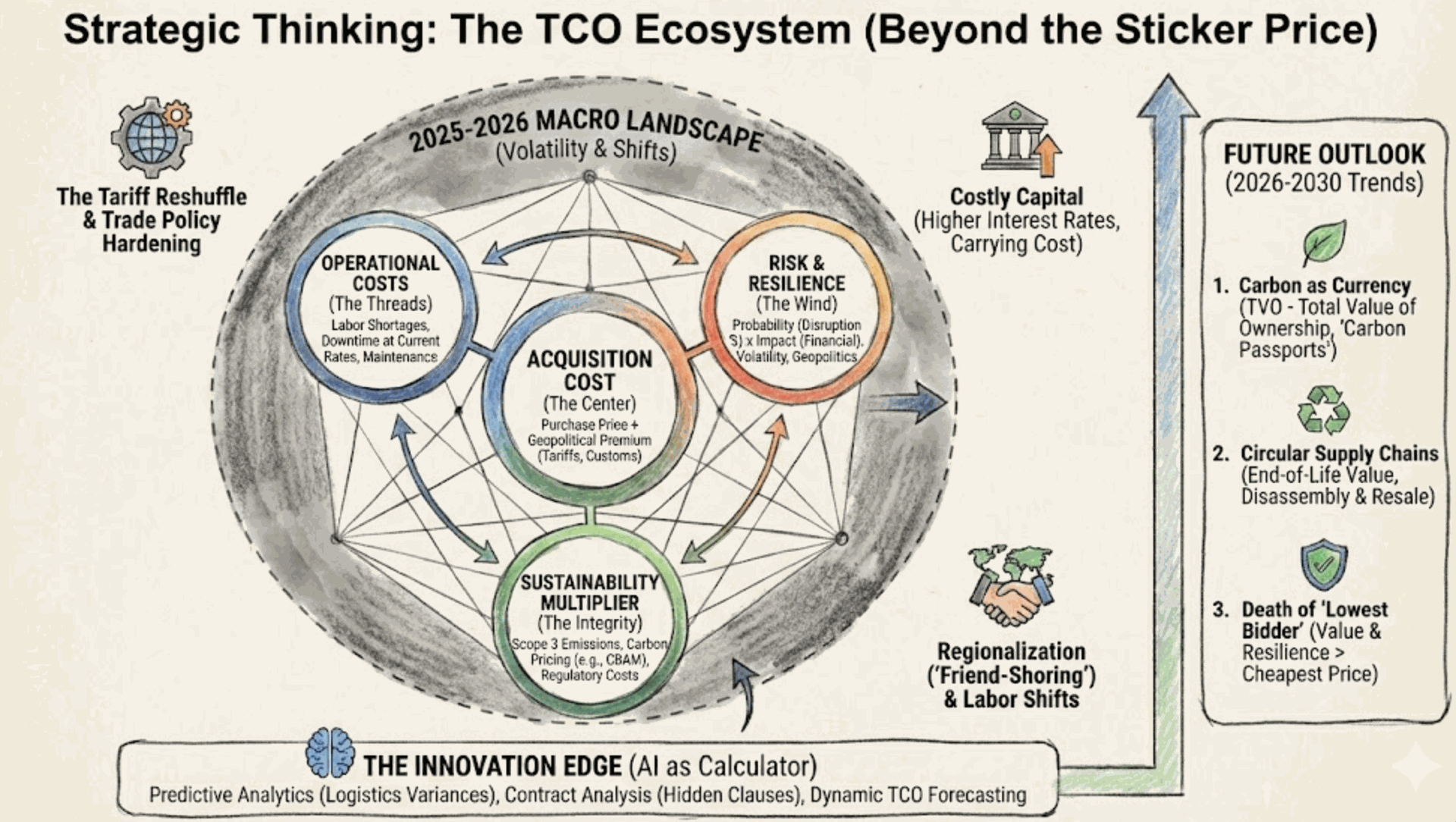
The "How-To": Mapping Your TCO Ecosystem
Forget looking "under the water" like the old iceberg model suggested. Instead, visualise your purchase as the center of a spiderweb. TCO is the sum of the tension on all the threads. Here is how to calculate it in the modern era:
1. Acquisition Costs (The Center)
This is your purchase price, but in 2026, it includes the "Geopolitical Premium."
- Action: When comparing suppliers, add the cost of potential tariffs and customs delays immediately into your spreadsheet. Do not treat them as "unexpected."
2. Operational Costs (The Threads)
In "The Cheap Trap," we mentioned maintenance as a hidden cost. But now, we must view it through the lens of labor shortages.
- The 2026 Twist: A cheaper machine that requires frequent manual servicing often has a higher TCO than an expensive, automated unit, simply because finding skilled technicians in 2026 is difficult and expensive.
- Action: Factor in "downtime cost" at your current labor rates, not last year’s.
3. Risk & Resilience (The Wind)
The iceberg model treated risk as a static hazard. The Ecosystem model treats it as a probability.
- The Calculation: (Probability of Disruption %) x (Financial Impact of Disruption).
- Example: If a supplier in a volatile region has a 10% chance of failing, and failure costs you $50,000 in lost sales, add $5,000 to their TCO immediately. Recent reports highlight that firms prioritizing resilience over lowest price are outperforming competitors in shareholder value.
4. The Sustainability Multiplier (The Web’s Integrity)
This is no longer just "good will"; it is a line item. With the expansion of carbon pricing mechanisms like the EU’s CBAM (Carbon Border Adjustment Mechanism), carbon emissions now have a literal price tag.
- Action: You must calculate Scope 3 emissions (emissions from your suppliers). If a supplier is "dirty," you may eventually pay the tax for their carbon footprint.
The Innovation Edge: AI is Your Calculator
If this sounds too complex for a manual spreadsheet, you are right. This is where technology bridges the gap.
Generative AI has moved from a "fun experiment" to the "Plateau of Productivity." Small businesses can now use AI-driven procurement tools to predict TCO variances.
- Predictive Analytics: Instead of guessing shipping costs, AI tools can now forecast logistics variances based on weather and route disruptions, giving you a dynamic TCO rather than a static estimate.
- Contract Analysis: AI can scan supplier contracts to flag "hidden" inflation clauses or penalties that would otherwise increase your TCO six months down the line.
Future Outlook: The Next 5 Years (2026-2030)
Where is this going? If you are a student entering the workforce, or a business owner planning for longevity, watch these three trends:
- Carbon as Currency: TCO will eventually evolve into TVO (Total Value of Ownership), where the carbon cost is weighed equally with the financial cost. We will likely see "Carbon Passports" for products, where the emissions data travels with the item.
- Circular Supply Chains: The "End of Life" cost in TCO will flip to "End of Life Value." Companies will pay less for products that can be easily disassembled and resold. Scope 3 market instruments are already creating financial incentives for this circularity.
- The Death of the "Lowest Bidder": The era of the lowest sticker price winning the contract is over. The volatility of the 2020s has taught us that the cheapest option usually carries the most expensive risks.
Conclusion
The "iceberg" was a warning to be careful. The TCO Ecosystem is a mandate to be smart.
We started this journey by identifying the trap of cheap prices. We moved on to building the relationships that sustain us. Now, we arrive at the final piece of the puzzle: the rigorous, data-driven discipline of calculating true value.
For the small business owner: stop buying based on the invoice price. Start buying based on the lifecycle value. For the university student: don’t just learn how to negotiate a price; learn how to architect a value chain.
The costs aren't hidden anymore. They are right there in plain sight, connected, active, and waiting for you to manage them.