Welcome to the first instalment of my digital transformation series. As a professional who has navigated supply chain management, ERP implementations, and business operations, I’ve seen what separates successful digital evolutions from costly technological tragedies. Today, I dismantle a critical mechanism: the Business Impact Assessment (BIA).
When looking at digitalisation, throwing modern technology at an operational problem without understanding the ripple effects is a recipe for disaster. Let’s explore what a BIA truly entails in today’s landscape, relying on hard data rather than industry assumptions.
The Current Scenario: Moving from Linear Chains to Digital Networks
Global supply chains are incredibly volatile, and digital transformation is a survival mandate. However, the data paints to a sobering picture. According to long-standing research from McKinsey & Company, approximately 70% of digital transformation initiatives fail to meet their original objectives.
Why? Because organisations dive headfirst into implementing new ERP platforms without a baseline understanding of how these tools will disrupt their operations.
Deloitte correctly points out that modern supply chains are shifting from traditional, linear nodes into dynamic "Digital Supply Networks" (DSNs). In this interconnected web, a change in procurement software immediately impacts warehousing and financial forecasting. A Business Impact Assessment serves as your operational blueprint, quantifying the impacts of disruptions and aligning IT investments with overarching strategic business objectives.
Where the Industry Has Failed: The 56% Value Deficit
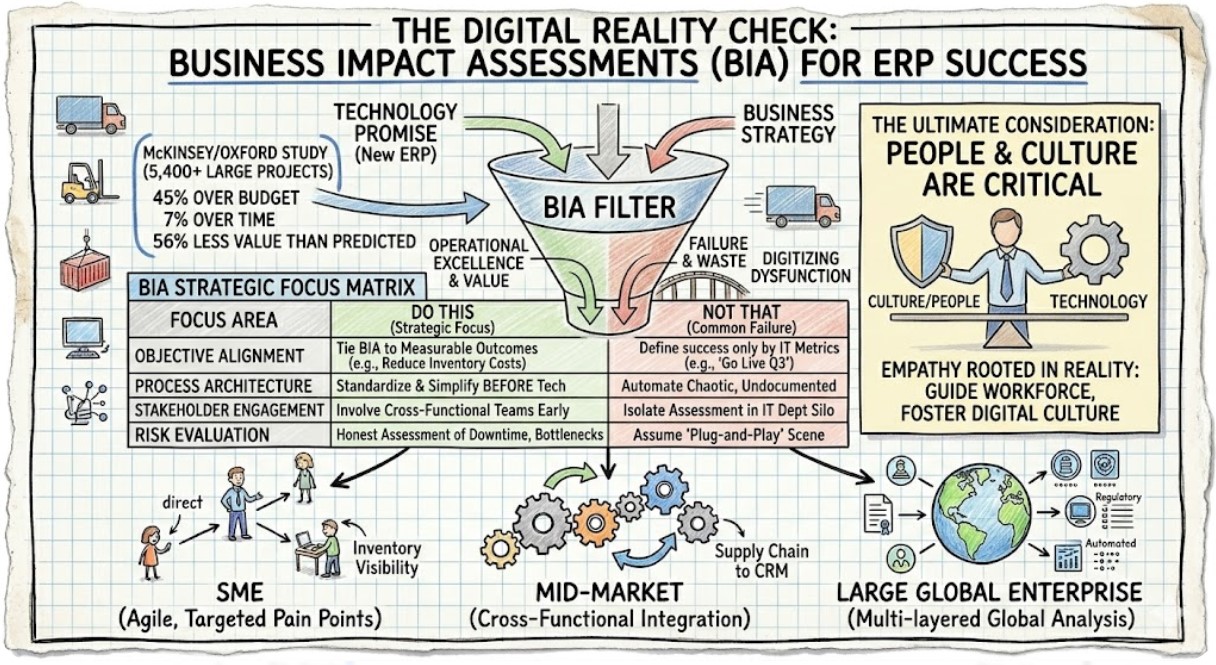
To understand how to succeed, we must look at what fails. A landmark joint study by McKinsey and the University of Oxford analyzing over 5,400 large-scale IT projects (those with budgets over $15 million) revealed a staggering reality: these projects run 45% over budget, 7% over time, and deliver 56% less value than predicted.
These failures happen when companies fall into the "Technology Trap", digitising dysfunction instead of fundamentally re-engineering broken legacy processes.
Other common failures include:
- The Go-Live Shockwave: Launching without assessing the operational readiness of the warehouse floor, leading to immediate supply chain chaos.
- Scope Creep: Yielding to internal pressure to heavily customize a new ERP to mimic the old system, destroying the scalable architecture of the new software.
- The IT Silo: Treating an ERP rollout purely as an IT project rather than a holistic business transformation.
The Do's and Don'ts of Business Impact Assessments
| Strategic Focus | What You Should Do | What You Should Not Do |
| Objective Alignment | Tie the BIA to measurable business outcomes (e.g., "reduce inventory holding costs by 15%"). | Define success purely by IT metrics (e.g., "go live by Q3"). |
| Process Architecture | Standardise and simplify operational processes before applying technology. | Automate existing, chaotic, or undocumented manual workflows. |
| Stakeholder Engagement | Involve cross-functional teams early, from the warehouse floor managers to the C-suite. | Isolate the assessment within the IT department. |
Scaling the BIA: One Size Does Not Fit All
- Small to Medium Enterprises (SMEs): A BIA should be lean and highly focused on immediate pain points (e.g., inventory visibility) to achieve rapid ROI without overcomplicating the tech stack.
- Mid-Market Companies: Focus heavily on integration. How will the new supply chain module talk to your existing CRM? The assessment must identify integration bottlenecks.
- Large Global Enterprises: Require comprehensive, multi-layered BIAs assessing the impact on deeply entrenched legacy systems across multiple geographies and regulatory environments.
The Ultimate Consideration: People and Culture
Technology does not transform businesses; people do. If your Business Impact Assessment only analyses data flows and ignores the cultural shockwave of a new system, you are setting the stage for massive internal resistance.
the second installment is on its way for more insights.