Say your bottle-cap supplier sends a letter. Resin is up 15%, freight is up, tariffs are "uncertain," so from next month the price moves from $18.00 to $19.80 per thousand. That's a 10% increase, explained in one polite paragraph with no numbers attached.
Most buyers do one of two things. They push back on gut feel and settle somewhere around 6 or 7%, or they accept it because "that's the market."
Now run it through a simple cost model. A plastic cap is resin, moulding time and some overhead. If resin makes up about 40% of the price, that's $7.20 per thousand. A 15% resin increase adds $1.08, which is 6% on the total. So the supplier is asking for 10% and resin explains 6. Freight and tariffs might account for some of the rest, and now the supplier has to show how much. The numbers here are illustrative; the logic isn't.
That's should-cost thinking in its simplest form. We stop arguing about what the price feels like and start building it from what it's made of.
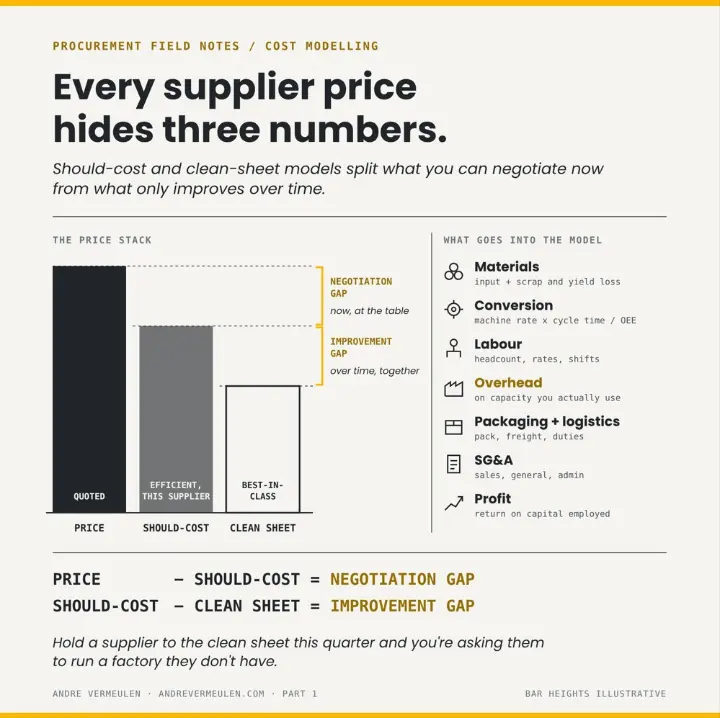
Where Did Should-Cost Come From?
The method has a long paper trail. In 1969 a US congressional subcommittee raised concern that pricing military contracts mainly on a contractor's historical costs wasn't protecting the government. It recommended the General Accounting Office look at a should-cost approach that estimates what a system ought to cost given an attainable efficiency, using industrial engineering and financial analysis, and GAO ran trial reviews. That logic still sits in US federal procurement rules today: FAR 15.407-4 splits should-cost reviews into program reviews, focused on direct costs like labour and material, and overhead reviews, focused on indirect costs.
Commercial procurement picked up the same idea, and it's now sold as a packaged capability by firms like McKinsey under its Cleansheet offering. So this isn't new. What separates teams that get value from it is how well they build and use the model.
Clean Sheet or Should-Cost: Aren't They the Same Thing?
A lot of glossaries treat them as one thing. Aavenir's procurement glossary, for example, lists clean-sheet costing, teardown analysis and open-book costing as other names for should-cost analysis. In practice it pays to keep them apart, because they answer different questions.
Should-cost models this supplier: their plant, their equipment and their overhead, run efficiently today. The question it answers is, "What should this supplier be charging us right now?"
Clean sheet models the best way anyone knows to make the product: a best-in-class process with no legacy equipment, at the volume you buy. The question it answers is, "What could this cost if it were done the best possible way?"
Put the three numbers side by side and you get two very different gaps:
- Price minus should-cost = the negotiation gap. This is margin or inefficiency the supplier can give back now, at the table.
- Should-cost minus clean sheet = the improvement gap. This only closes over time, through process change or investment, usually done with the supplier.
Mixing the two is where supplier relationships go bad. Holding a supplier to a clean-sheet price this quarter is asking them to run a factory they don't have.
What Goes Into the Model?
Whatever the category, the building blocks are much the same:
- Materials: what goes into the product plus what's lost to scrap and yield, priced at market or index rates.
- Conversion: machine rate multiplied by cycle time, adjusted for real equipment performance. Overall equipment effectiveness (availability x performance x quality) is the usual way to get from theoretical to actual output.
- Labour: direct and indirect headcount, local wage rates, shift patterns and overtime.
- Overhead: factory costs allocated by the activities your product actually uses, which is the core idea behind activity-based costing.
- Packaging and logistics.
- SG&A: the supplier's sales, general and admin costs.
- Profit: ideally a fair return on the capital the supplier ties up serving you, not a flat percentage stacked on everything above it.
The block suppliers defend hardest is overhead. Say a supplier runs at 40% utilisation and you're their biggest customer. The easy move is to load a large slice of their fixed cost onto your price. Your share of overhead should follow your share of the capacity you actually use, not the cost of their idle lines.
The same blocks work for services, the weight just shifts. In a cleaning or security contract almost the whole price is people: how many per site, the wage for that role and location, statutory on-costs and supervision, then overhead and margin. Public wage data makes the labour line one of the easiest to check, and long-running contracts often carry a supervision ratio or margin nobody has looked at in years.
How I would Build One in Practice
- Map the process before the numbers. Walk from raw material to delivered product and question every step: does the end customer pay for this, and is our own specification causing it?
- Break the price into drivers. Go one level deeper than feels necessary. "Labour" becomes headcount, rate, shifts and overtime.
- Source every input from more than one place. Commodity indices, labour statistics, equipment makers' specs, supplier financials, plant visits and past bids. When two sources disagree, that's the line to dig into.
- Run sensitivity analysis. Usually three or four drivers move the total. Spend your data-gathering time there, not on the rounding errors.
- Take it to the supplier as questions. Asking "what yield are you running on this line?" gets you real information; "your price is too high" gets you a defensive reply. Let the supplier correct your assumptions, and update the model each time they do.
- Write the result into the contract. Once you agree how the price is built, tie the material share to a published index. The next resin move then adjusts the price by formula, up or down, instead of by letter.
Expect pushback. "I can't break my price down" usually gets a simple answer: somebody built this quote, we're not asking for your ledger, just the main assumptions behind what you're asking us to pay. If they ask to see your model first, keep the focus on their numbers; you can share yours once you understand theirs. And "you're a difficult customer" is worth taking seriously. If your forecast changes or rush orders are driving cost into their plant, ask them to quantify it. Now you've found a saving on your own side of the table.
Where It Goes Wrong
Most of the failures have little to do with the spreadsheet maths.
A should-cost model is a set of assumptions, so treat the output as a range. Teams that present one precise number lose credibility the moment the supplier corrects a single input. Inputs also go stale. Resin, energy and freight move every quarter, and a model built in January can be wrong by June.
The bigger risk is using the model as a hammer. When RAND reviewed the US Air Force's experience, it found limited and mixed evidence that should-cost reviews saved money compared with other pricing approaches, and few people with the skills to run them. A model handed over as an ultimatum gets you a defensive supplier and a stalled negotiation.
Ownership matters too. McKinsey makes the point that cleansheet models need an owner and cost engineers with real category knowledge. A model a consultant built once and nobody updated is out of date by the next sourcing round.
And don't model everything. Even the FAR lists enough time to do the review properly and people with the right skills among the conditions for a full program should-cost review. Don't clean-sheet the stationery, and don't chase a cheaper piece price that brings more quality failures or longer lead times.
Is It Worth the Effort for Your Category?
Should-cost pays where spend is high, the cost structure is hidden, there are few alternative suppliers, or a price increase is on the table. It adds little where pricing already tracks a transparent index, or where spend is too small to justify the work. It also earns its keep before you ever go to market: a clean sheet built during product design tells you what a part should cost before a supplier quotes it.
It's just as useful when you're switching suppliers. In Deloitte's 2025 Asia Pacific tax and tariff survey of 363 executives, 41% said they would consider significant supply chain realignment even with cost increases below 20%. Realignment means new suppliers sending new quotes, and a should-cost model is how you compare a quote from Vietnam with one from Thailand on substance rather than headline price.
Results vary a lot by item. In one McKinsey client portfolio, cleansheet-identified savings opportunities ranged from 2% to 95%, which is why you start small. McKinsey's own suggestion is to pick one commodity, build cleansheets for two or three parts, then extend the logic across similar items. The effort barrier is dropping too: GEP argues AI can now read engineering drawings and build cost models in a fraction of the time, but can it really? A faster model built on a wrong yield assumption is still wrong, though, so the checking step stays. That's how we'd start: pick the category with the price increase sitting on your desk and build one model before the supplier meeting.
Back to the bottle-cap letter. The buyer who answers with a counter-offer settles at 7% and has the same fight next year. The buyer who answers with "resin explains six points, walk us through the other four" ends up with an agreed cost breakdown and an index clause, so next year's resin move gets settled with a formula.
Part 2 of this series takes the same model into the January 2027 price letters: what's driving costs now, how big an increase should be, and how to plan contingency for 2027. Read Part 2: January 2027 Supplier Price Increases. (Coming soon).
I'm not good with Graphic Design, all the images are AI generated.