Welcome back to my series on navigating digital transformation. In my last post, we established why the Business Impact Assessment (BIA) is your critical first step. Today, we are tackling the engine that actually drives the transformation: Change Management.
The Current Scenario: The Human Bottleneck
We live in a world where technology evolves exponentially, but human adaptability remains linear. When you introduce a new cloud ERP or an AI-augmented supply chain tool, the software functions exactly as programmed. The people, however, do not.
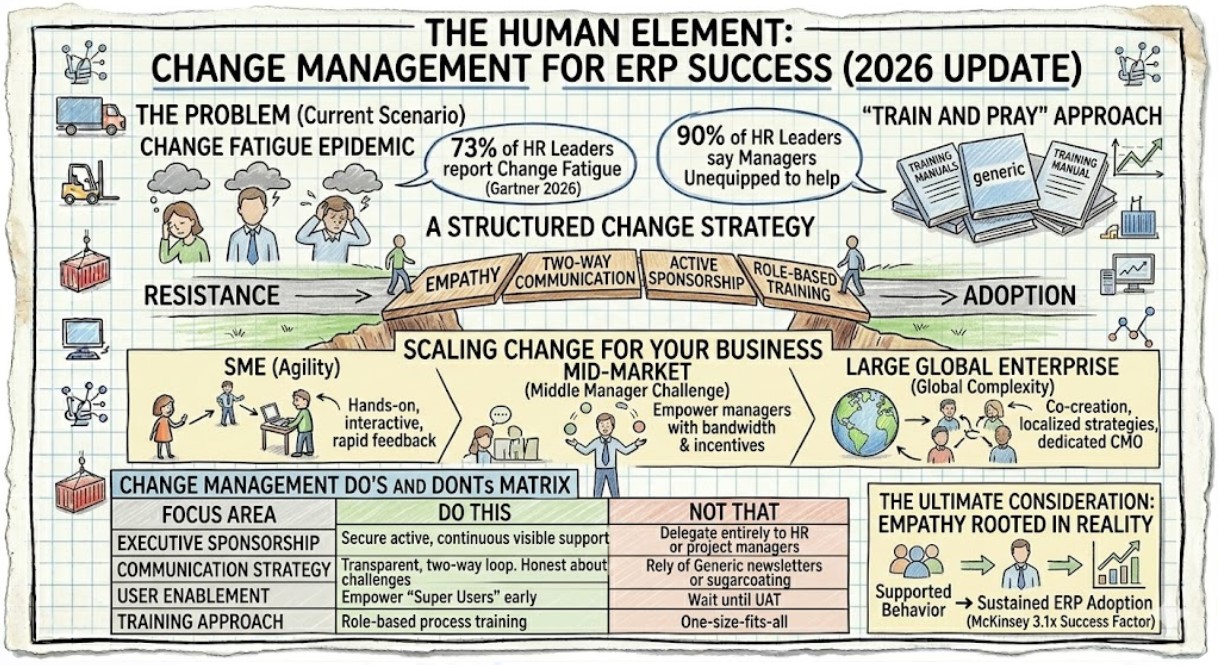
The latest Gartner Top HR Trends and CHRO Priorities for 2026 reveals a striking reality regarding Change Fatigue. Currently, 73% of HR leaders report that their employees are suffering from change fatigue due to relentless, compounding organisational shifts. Even worse, nearly 75% of those same leaders admit their managers are not equipped to help employees navigate this exhaustion.
Furthermore, McKinsey & Company's latest insights on radical transformation confirm the old, stubborn mantra: 70% of change programs still fail. However, they also found that when organisations establish a clear "change story" and robust management support, their success rate is 3.1 times higher.
Leadership often confuses training with change management. Deloitte's research on ERP Transformation emphasises that technology alone is never enough; true value comes from users streamlining processes and redefining roles. It’s not just teaching a warehouse manager which buttons to click; it is shifting how they trust automated systems over historical gut feelings.
Where the Industry Has Failed: The "Train and Pray" Approach
When ERP transformations fail, it rarely looks like a server crashing. It looks like a procurement team quietly exporting data back into Excel because they don't trust the new dashboard.
The most common failure point is the top-down, "Train and Pray" methodology. This happens when leadership mandates a new system, isolates the project team in a boardroom for a year, and then drops a thick training manual on the users' desks two weeks before Go-Live.
Other fatal missteps include:
- The Communication Black Hole: Treating the ERP implementation like a secret IT mission, leaving the wider organisation to rely on watercooler rumors.
- Ignoring the "What’s In It For Me?" (WIIFM): Failing to articulate how the new system benefits the end-user. If a logistics planner only hears about "corporate ROI" and not how the system will save them two hours of manual data entry a day, they will resist.
- Underestimating the Loss of Expertise: A 20-year veteran of your supply chain operations might suddenly feel like a novice on the new system. Ignoring the emotional toll of this status loss breeds immediate resentment.
The Do's and Don'ts of ERP Change Management
To successfully anchor change in your organisation, you must balance empathetic leadership with candid, structured expectations. Here is your framework for success:
| Change Management Focus | What You Should Do | What You Should Not Do |
| Sponsorship | Secure active, visible, and continuous support from executive leadership, not just at the kickoff meeting. | Delegate change management entirely to HR or a mid-level IT project manager. |
| Communication Strategy | Implement a transparent, two-way communication loop. Be honest about upcoming challenges. | Rely solely on generic corporate newsletters or sugarcoat the difficulties. |
| User Enablement | Identify and empower "Super Users" or change champions across different departments early in the project. | Wait until the User Acceptance Testing (UAT) phase to let the actual floor workers see the system. |
| Training Approach | Provide role-based, contextual training that focuses on the new business process, not just the software clicks. | Deliver generic, one-size-fits-all training sessions that ignore specific daily operational realities. |
Scaling Change Management: From SMEs to Global Giants
Change management is not a monolithic template; it must be right-sized for your operational footprint.
- Small to Medium Enterprises (SMEs): The advantage here is proximity. Change management should be highly interactive, face-to-face, and agile. The focus is on immediate reassurance, hands-on coaching, and rapid feedback loops.
- Mid-Market Companies: Here, you face the challenge of middle management. With Gartner reporting that 75% of managers are unequipped to lead change, your strategy must provide these managers with the bandwidth, training, and incentives to lead their teams through the transition without burning out.
- Large Global Enterprises: Scale introduces massive complexity. You must shift from a top-down mandate to co-creating change strategies with employees globally, accounting for varying regional labor laws and cultural attitudes toward technology.
The Ultimate Consideration: Empathy Rooted in Reality
The most formidable ERP systems in the world are ultimately at the mercy of the people tasked with using them. Acknowledge that learning a new system is exhausting, especially given current change fatigue levels. Validate their concerns, but ground that empathy in reality: the market is moving, the digital supply network is the future, and standing still is not a viable business strategy.